The Altars We Didn’t Know We Made (or Needed)

Remember me
Though I have to say goodbye
Remember me
Don’t let it make you cry
For even if I’m far away I hold you in my heart
I sing a secret song to you each night we are apart

Remember me
Though I have to travel far
Remember me
Each time you hear a sad guitar
Know that I’m with you the only way that I can be
Until you’re in my arms again
Remember me

REMEMBER ME (LULLABY)

Let’s be honest—thanks to popular culture, there is curiosity around El Día de Los Muertos, or Day of the Dead. This Mexican holiday is celebrated on November 1 and 2 to honor and remember deceased loved ones. It is a joy-filled remembrance of life that involves building altars (ofrendas) with offerings, visiting and/or decorating graves, and sharing memories with family. The holiday blends ancient Mesoamerican and Spanish traditions into a celebration that welcomes the spirits of the dead for a brief reunion.

In recent years, this observance has taken on new meaning for me as more loved ones have passed from this life. It may sound selfish, but the idea of dedicating time to remember the most important people in our lives feels far more significant than some of the material-centered holidays we often celebrate. And while Día de los Muertos can be a grand, communal celebration, it can also be quietly observed in solitude.

Lately on social media, many creators have shared their stories, videos, and photos of their ofrendas. Some are elaborate and ornate, while others are simple and serene. Both are equally meaningful. At the same time, I’ve noticed conversations about who is “allowed” to participate, with some insisting on cultural credentials to take part in this day of remembrance. Yet, the overwhelming sentiment remains: we’ve all experienced loss, and the desire to honor those who shaped us is something universal.

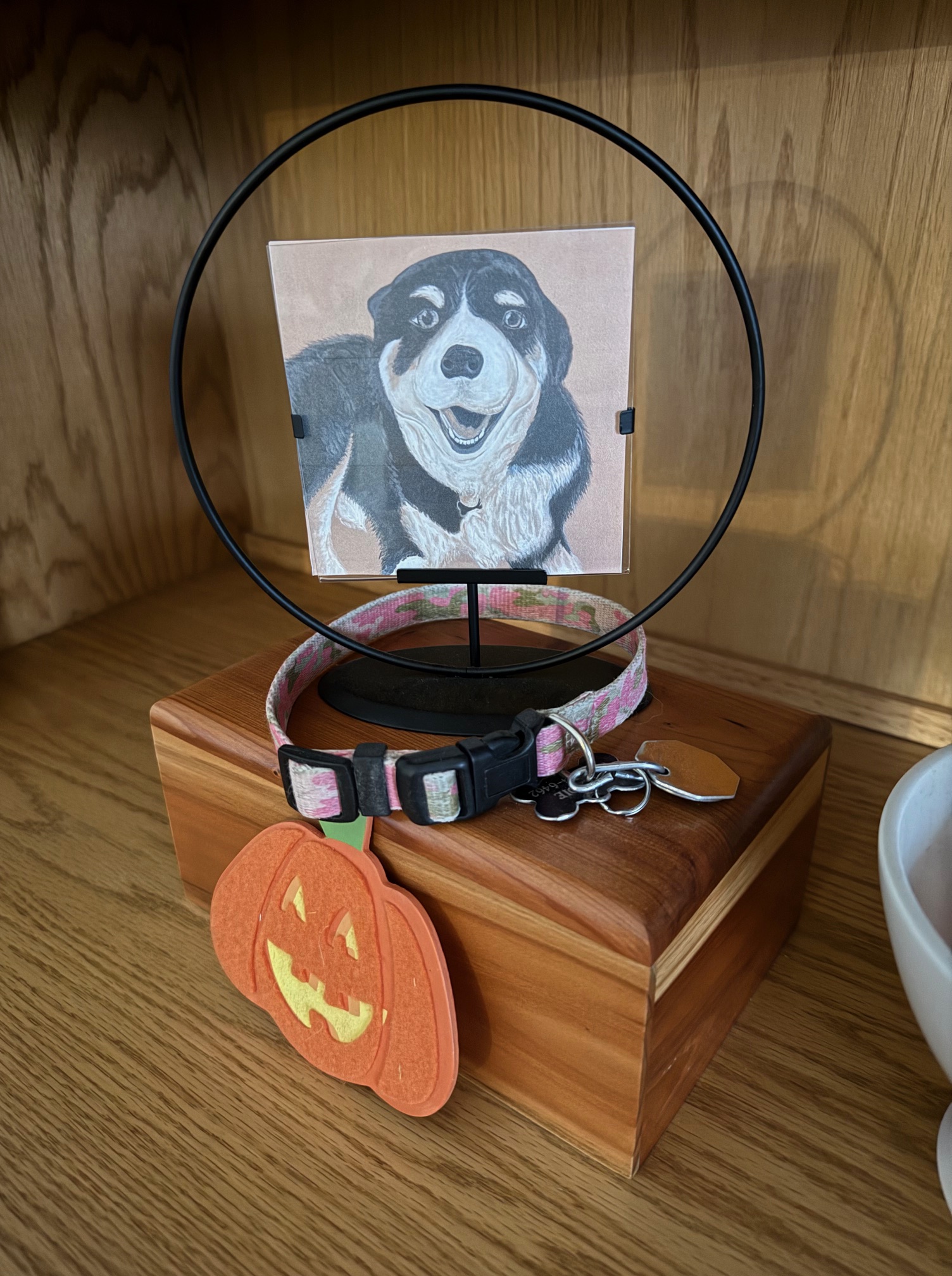
A few days ago, I began putting out my Halloween decorations. As a 50-year-old empty nester, I don’t need to do this—and some might argue I shouldn’t—but Halloween has always been one of my favorite holidays. I have such fond memories of it from childhood and of celebrating it with my own kids. What started as a plan to display a few old photos of my kids in their costumes quickly turned into a full-blown decorating session. On the built-in shelves, I decorated every corner, including two spaces where I already have photos of my mom and mother-in-law, and my sweet dog, Madeline.

These memorials stay out year-round. In realizing that, I saw that I had already created my own version of an ofrenda—a quieter one, perhaps, but deeply meaningful. It’s something I see every day. A space that holds memories 24/7. A space I could never imagine packing away. Every time I look at it, I thank God for blessing me with such beautiful souls in my life, even if only for a season.

In the Bible, altars were sacred spaces for worship, sacrifice, and offering—first built by Noah, Abraham, and others. They were places of remembrance, of unity, of meeting with God. Thinking about that reminds me of one of my favorite passages, Joshua 4:6–7, where God tells His people to stack stones by the Jordan River as a lasting reminder of what He did for them:

“In the future, when your children ask you, ‘What do these stones mean?’ tell them…”

Both the altar and the memorial stones tell the same story: that remembering matters. That marking what—and who—has shaped us is a sacred act.

I’m not going to tell you to build an altar in your home or decorate an ofrenda. But I will encourage you to make space for remembrance—a moment, a corner, a conversation, or even a prayer—to honor those who came before you and hold space in your heart. Whether through tradition, faith, or personal reflection, remembrance roots us in gratitude.

After all, memory itself is sacred.

Now, tell their stories.
None of Us are Good at Tragedy

All of the wrong things will be said.

And we will never hear enough of the right things.

The sadness, shock, and the fact that most of us are ill-equipped to deal with the bad stuff, the sad stuff, the unexpected, and especially grief means that we will likely screw things up. And we will screw it up more than once. I’ll say it again, none of us are good at tragedy.

As news of the D.C. crash broke, our sadness and disbelief quickly moved into blame, conspiracy theories, and political division.

If you’ve ever found yourself in a situation where you needed to offer grace, empathy, sympathy, aid, or any kind of support, you know that these things are not easy to do. Most of us spend our lifetime trying to avoid the bad stuff. It makes sense. None of this comes naturally. We are all flawed humans. No one wants to be in a situation like this. And yet, the reality is that we will experience tragedy and experience it more than once.

In these vulnerable times, we feel the need to clap back, answer back, and make sure that we’re heard…and maybe we shouldn’t. As we try to “do something,” soothe our own anxiety and find reason and explanation for the unexplainable, our sadness manifests itself as anger. Rather than crying, we lash out or worse—we post a zillion things on social media. According to therapists, everyone wants to be helped, heard, or hugged in times of stress or crisis. So often, in our attempts to satisfy these needs ourselves, we take the easiest route and cast blame while screaming at the top of our lungs, “This isn’t fair! It’s not right!” And it isn’t. The hardest part of tragedy and grief exists in the silence. Seeking to be helped, heard, or hugged may meet a need in the moment, but true healing is a long and slow process.

We can’t win here. People want answers, demand answers, and in the haste to give the people answers, we can say some pretty nasty things. We say unhinged things. We say dismissive things. We even make up things. We’ve been conditioned or maybe entitled to feel like we need to know and we need to know right now. Oftentimes we turn to authority figures, experts, and the news media for answers forgetting that they, too, are flawed humans who are also not good at tragedy. We love to make our politicians, law enforcement, religious leaders, and anyone who we don’t like or agree with into the enemy when we should be coming together in love, empathy, and understanding. While we can’t do much in these times of tragedy, we can honor others by offering prayers and extending peace.

You already know this, but these things are cyclical. We have quickly moved from disbelief and sadness to blame and now we’re learning the stories of the lives of the precious souls on Flight 5342 and in the helicopter that night. We mourn the loss while seeking answers and then we will wait. The news cycle, the political discourse, and life move on.

I am not good at tragedy. My heart has been broken enough times to know that this is part of life and no one escapes it. I take seriously the call to do no harm and offer my deepest condolences to the families and friends of those lost.

The Lord is close to the brokenhearted and saves those who are crushed in spirit. Psalm 34:18

A (Figurative) Kneeler in Every Home (A Call to Act Rather than Complain)

As a kid, I spent a lot of time at my grandmother’s house. I credit her with teaching me so many things (some of the biggest parts of my personality I can directly attribute to her), but the most important thing she taught me was how to pray. Through her, I learned that I was created on purpose and for a purpose. She took me to church and reminded me that God loved me unconditionally. She showed me that nothing was beyond forgiveness. In my opinion, she was the greatest example of a Christian woman I have ever known.

In her home, she had a kneeler. I don’t think I’ve ever been in a home with its own kneeler (before or since). It was a beautiful piece, made of wood with a lovely stain and it had a velvety cushion for your knees. (There’s a chance that my Papa made it, but I’m not 100% sure.) If you’ve never seen a kneeler I asked AI to generate what I can remember and the above rendition is pretty close. I was absolutely enamored with it! It was like having a church in your own house! The kneeler was designed to fit an adult, so as a small child, I couldn’t kneel and rest my hands on the top to pray. I knew you weren’t supposed to stand on the cushion, so what was a kid to do?

My grandma told me that you didn’t need a kneeler to pray. You could pray anywhere and at any time. While I knew that someday I would be able to reach the top of the kneeler, that little piece of assurance stuck with me. As a kid, I was plagued with nightmares. Praying helped. I’ve been a news junkie since I was in grade school and knowing about a big scary world caused me to worry and fear. Praying helped. Moving away from home and my support network was hard. Praying helped. Notice that I said that praying helped. It didn’t magically solve everything, but what it did do was deepen my faith and relationship with God. A God who pursues each of us, who hears and understands our worries and concerns, and reminds us that we are not alone even on the most friightening days.

It’s disheartening to know that so many disregard the power of prayer. It’s become a mode of attack in our modern culture to mock those who extend thoughts and prayers in times of crisis or as a way of offering comfort. Understand that praying people know that they are not lifting up their worries to a genie in the sky who will magically fix the ills of the world. Those of us who pray know that God is so much larger than that interpretation. The power of prayer is in the communication with our Creator. This is not lip service. Fervent prayer is action. It is often through prayer that we are called to act AND do more as we respond to the needs of others.

In the uncertainty of this new year, I have seen so many seek to complain and rile up their circles and communities. Many are calling out others, dividing families and friend groups, asking each other to take sides, and demonizing those who have differing thoughts and opinions. Several are canceling those who they once considered close and blocking people who they once called family or friends. This does so much more harm than good and it’s not taking place among those who don’t believe, this is happening within our own churches and communities of faith.

This is now a time for real in-depth conversations, in-person relationships, and profound listening. These things don’t take place in news stories, political chatrooms, or on social media. They take place around the table, in homes, and with open minds and hearts.

Please do not contribute to the hate, division, and fear that currently surrounds us. Pray and ask for discernment. Ask God to use you. Think before you speak (or post) so that you can be a source of hope and peace. Prayer is action. In this distressed world, many only contribute to the anxiety by spreading information that has not been fully researched or confirmed. News and information move at lightning speed and it is easy to get caught up in this vicious whirlwind.

At this point, I am again reminded of my grandma and her assurance that we can pray anywhere and at any time. I am more certain than ever that we need a (figurative) kneeler in every home to pray and hear God’s call and we need real-life, in-person conversations to listen and respond with compassion in order to truly make a difference, even if it’s only in our own tiny corner of the world.

This is not lip service. Fervent prayer is action.

In my distress I called upon the Lord; to my God I cried for help. From his temple he heard my voice, and my cry to him reached his ears. Psalm 18:6

Puppy Tales: In Loving Memory of Maddie

Madeline Rose Spencer, April 2008-September 2023

“Dogs leave paw prints on your heart.”

—Anonymous

Everyone should have a cup of coffee with a dog. Just try to make sure it’s not the same cup. More on that in a moment….

Losing a dog is hard. No one tells you just how hard it will be. After almost fifteen years, our Maddie is gone. She was the absolute best dog. That’s easy for me to say, but I wholeheartedly believe it. I had no idea what we signed up for when we brought her into our home. She was a gift for my son’s 7th birthday and as crazy as it sounds, we found her on Craigslist. Really. We loaded up the “swagger wagon” (our minivan) and hotfooted it 70 miles north to Lindsborg, Kansas to pick her up. The whole thing was sketchy. Really. Top to bottom sketchy, but we headed back home with a four month old Aussie and some super excited kids in the backseat.

I always claimed to be a dog person, but the reality is that I was more of a dog-adjacent person. Meaning that I like dogs (way better than cats) but I had also never had a dog of my own. Sure we had dogs growing up, however, they weren’t my responsibility. EVER. I can recall letting the dogs in and out and occassionally feeding them, but that’s the extent of my dog experience.

My son, Sean, always wanted a dog. ALWAYS. He had a stuffed dog as a baby and just seemed naturally drawn to dogs. He wanted a dog as a toddler. He wanted a dog as a preschooler. He wanted a dog…well, you get the picture. We told him that as soon as we had a house with a fenced backyard we would get a family dog. In July 2008, we moved into a house and had a dog by September. He held us to our word.

I could write novels on all of Maddie’s adventures. She was a herding breed and exercised that trait over and over. The poor kids were frequently rounded up and pinned up against trees, fences, the house…you name it. The more they screamed, the more excited Maddie got. Maddie was tiny when we got her, but it’s hard to imagine her that way because she grew up alongside the kids. My daughter, Casey, baptized Maddie an innumerable amount of times and both kids taught her tricks. She escaped the backyard on Christmas Day resulting in the Great Snowscape of 2008. Maddie knocked our Christmas tree over too many times to count. We discovered she had an affinity for sugar cookies…both baked and unbaked, resutling in several cookie capers and vomit. There was Maddie’s Deep Depression Era the summer when her fur was shaved to all of our horror! She was incredibly protective. She let her presence be known every time someone came in or out of the house. She nipped at everyone, even Sean and Casey whom she saw every day. We’re pretty sure she only actually got a hold of one person’s backside, but I can’t verify this. This dog. Oh, how we loved her.

Maddie was named after the character with the same moniker from “The Suite Life of Zach and Cody” show on Disney Channel. I started calling her Madeline because I love the Madeline books and I felt like it had a little more gravity when I was trying to be stern with the dog…this of course never worked. Maddie or Madeline, she remained indifferent and only listened when it suited her.

I’m grateful for the time we had together. Our family is better for it. Maddie brought joy, laughter, antics, adventures, and occasionally bewilderment to our household. She was all personality. She was the softest dog on the planet, and I can say this with all certainty because that was one of the most common compliments she received. She was beautiful and at almost 15 years had practically no gray at all to her coat. We loved to take photos and videos of her…running, playing with her toys, catching the ball, sleeping on the couch when she wasn’t allowed to be on the furniture…you get the picture. Casey had some of the best photos of her. Of course, Maddie wouldn’t pose…even if you bribed her, but Casey managed to get some great shots. I’m glad we have these reminders to keep her memory alive.

I’ll share my absolute favorite Maddie story now: Everyone should have a cup of coffee with a dog. Just try to make sure it’s not the same cup. When Maddie was a puppy she quickly became my sidekick. Not because I was her favorite (far from it), but because I was the one she got stuck with at home. Every morning Steve and kids would leave for work and school and Maddie would be with me. If you know me, I am not a morning person and thus coffee is vital for survival. I had the same routine. Get everyone out the door, pour myself a cup of coffee, set it on the coffee table in the living room and head back to the kitchen to fetch a bowl of Cheerios. We had one of those hand-me-down, low level ’70s coffee tables, the perfect height to put your feet up on or rest your coffee cup, but also the perfect height for a puppy to indulge herself in a new treat. Of course, Maddie wasn’t greedy. She’d just take a few licks from the top…while I was grabbing my breakfast. I was new to dogs, she was new to coffee and it was probably two weeks before I knew what she was doing. Caught in the act, I poured out the coffee, recalled the scene from Charlie Brown where Lucy goes nuts about dog germs, and started a new routine. If you’re going to walk away from your coffee cup, make sure it’s on a tall (very tall) surface. You might wonder how I wasn’t aware of this before, but as I mentioned earlier, I was a dog-adjacent person. Maddie and I, we learned together.

My coffee cup is safe now. I wish it wasn’t.

We love you, Maddie-girl. You are missed a thousand times every day.

A home without a dog is just a house.

anonymous

This is Why We Can’t Have Nice Things (Halloween Edition)

This song has been on repeat in my brain for several days now, almost like it’s haunting me. Not because I’m a Swiftie, not because of the recent Taylor and Travis love story (of which I am a big fan,) and not because I heard it on the radio recently. So obviously, I’ve been a little spooked as to what has triggered my most recent earworm.

This is why we can’t have nice things, darling
Because you break them, I had to take them…

TAYLOR SWIFT

I will admit that the song title has practically become a permanent part of my vocabulary lately. I’m not necessarily singing it, but I am saying it quite a bit. It’s become my standard response to politics, pop culture, the daily news, and especially relationships— “this is why we can’t have nice things.” Basically, it’s my feeble attempt to explain why things go wrong, people can’t get along, and miscommunication abounds. In other words, we’re all imperfect humans who don’t know how to talk to each other and so we take the easy road (and not the high road as some might have you believe) and we default to the cut-off. (Insert scream here!)

It’s become my standard response to politics, pop culture, the daily news, and especially relationships— “this is why we can’t have nice things.”

hymningandhaing.com

We refuse to hear each other out. It’s early October and already I’ve seen three videos and heard one podcast giving talking points about how to shut down your annoying relative over Thanksgiving dinner. There are how-to articles with tips on how to cut-off just about every type of relationship imaginable: boyfriend/girlfriend, husband/wife, parent/child, friends, coworkers, neighbors, acquaintances, and even strangers. What was once thought of as a jerk traffic manuever, cut-off has quickly become a scary way of life.

I’m not saying there aren’t reasons to cut people out of your lives. Clearly, there are. We all know that cut-off has been happening since the dawn of time. Still, it seems that with cut-off there’s a history of incidents or behavior between the parties involved where the cut-off might be warranted. This is why today’s new version of cut-off seems so violent. You can be talking to someone one day and then find yourself blocked or unfriended the next day. Yikes.

It’s almost as if cut-off has morphed into ghosting? (If you’re not familiar with ghosting, the dictionary defines it as the practice of ending a personal relationship with someone by suddenly and without explanation withdrawing from all communication.) It’s a little unnerving isn’t it? Unlike cut-off where there is an incident or series of incidences that lead up to the end of communication, ghostings often happens with no context whatsover. You exist, they exist, but you go about your lives as if you never knew each other. Creepy. Lately, I’ve been told by more than a handful of people that they’ve been ghosted by someone they thought they knew and trusted. Then poof…they’re gone.

At this point in my life, there’s been a lot of soul searching. I think it’s a natural part of maturing and aging. Maybe this is why this song has been resounding in my head AND my spirit. As we move into this political season and closer and closer to the holidays my heart is heavy. So often I’m reminded that relationships are the most important part of life. More important than jobs, money, status, ego…you name it. And yet here we are, so ready to throw people away. Is it really impossible for two parties to sit down and have a conversation? Perhaps find a way to air out their grievances and make amends? And if that’s not possible, at least understand the reason for the cut-off?

I can only speak for myself, but I have seen firsthand the pain and heartache associated with cut-off. I’m a big believer of forgiveness, living without regret, thinking before you speak, pausing before you act and trying to put myself in the other person’s shoes. None of which guarantees anything. But it’s a start. It’s scary out there. Without the effort, the song will hauntingly play on…”this is why we can’t have nice things.”

The tragedy begins, not when there is misunderstanding about words, but when silence is not understood.

Henry David Thoreau

“Griefing”…Marking Three Years (A Life Interrupted)

I’ve taken to making up words. I guess that’s what happens after three years. We’ve moved past the point of surviving and here we are in this new reality—”griefing.” No longer adjusting to life without Mom as we are in fact living our lives without Mom. As you can imagine, this brings about a whole new stage of sadness.

While in survival mode the days blurred together. My mind began noting all of the things she was missing. All the milestones, events, holidays and ordinary moments. I would catch myself saying, “Mom should be here.” In survival mode you look at the calendar and note how much time has passed. In this early stage of grief you remember where you were in the days leading up to her positive COVID test, ER visits, hospital stay and ultimately her death. In survival mode you are doing everything you can to just get by. Griefing is different.

Griefing is living daily with this neverending sorrow. I feel like it’s a permanent stage, one you can’t escape. It feels like a step that will neither get better nor worse. The memories exist, but we are now making memories without her. I hate this feeling. The sting is still there, the tears remain just below the surface and yet there is this awful resignation. Understanding that this is part of the human condition doesn’t make it better. Knowing that millions of people feel exactly the same way doesn’t make it any easier. It’s this hidden current that runs through society and no one wants to talk about it. Ever.

It’s interesting to me that in the aftermath of COVID we are hearing more about prolonged grief and complicated grief as mental health conditions. Many are receiving these diagnoses and seeking treatment. And while I understand that some of the characteristics of these conditions are severe (such as the inability to resume daily activites, etc) I also think that our failure to cope with loss has more to do with a lack of communication and overall empathy for one another. I could go on and on about the societal demand to resume our work schedule, home life and the call to return to “normal,” but these things have become a staple of modern living and will lkely never change.

There are some things in life that we will never fully understand, death being one of them. Losing my Mother has changed my perspective on so many things. I now posess a form of patience and compassion that surprises me to this day. I have been humbled in a way I could have never imagined. Empathy has changed how I react to everything. I am different now. I am griefing.

Writing has been my therapy, the best form of solace for my grief. Who knows where I will be in this journey a year from now, five years from now or even ten (if I am afforded that luxury). They say time heals all wounds. It doesn’t. I’ll stand by that.


“A Life Interrupted” is an ongoing series of blog posts dealing with the loss of my Mother to COVID-19.

All the Pieces (A Life Interrupted)

We are the living pieces of those who have loved us well.

Author unknown

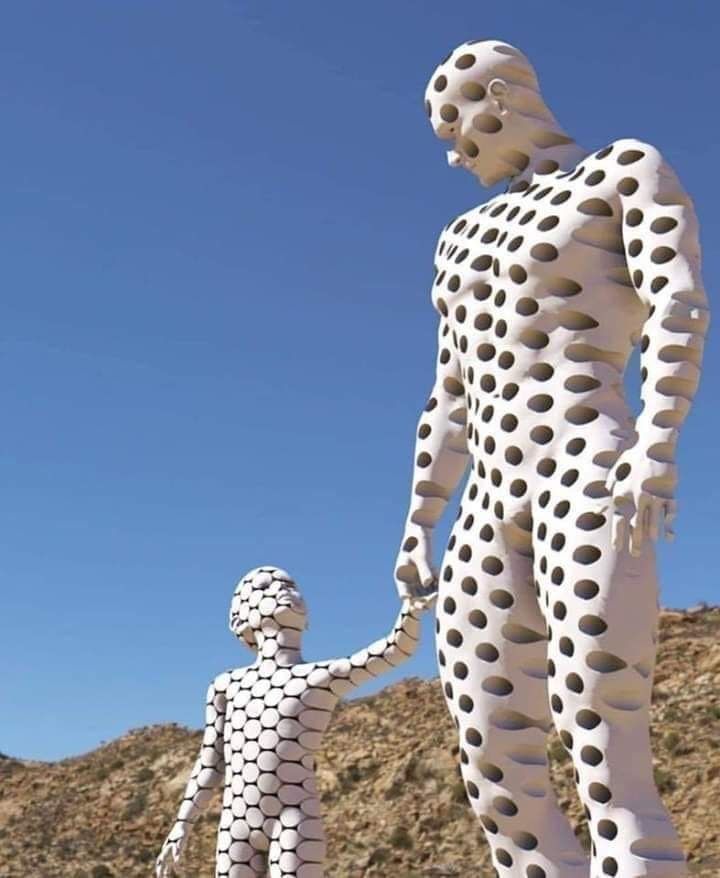
Several years ago I came upon this photograph while scrolling through my social media feed. It immediately caught my eye. Never before had I seen such an accurate depiction of parenting. I remember at the time searching for the name of the artist or the title of the piece, the location of the sculpture, and any information that could offer a clue as to whether or not my interpretation was correct. I came up with countless Pinterest board pins, a few blog posts, and an entry on Reddit but no true identifying information. I immediately took a screenshot and vowed to continue the research at a later date. (Yes, I do things like that.)

Fast forward and this was the image that immediately came to mind when my Mother passed away in May of 2020. In my mind’s eye, I could see the pieces of the parent sculpture arranged to make up the form of the child sculpture. Sort of like a personified “giving tree,” the adult figure surrendering pieces of itself to the growing child he/she loves so much. In essence, the child was all the pieces of its creator…and thus all the pieces of the ultimate Creator. Did I still have the photo on my camera roll? I did a quick search. Yes, I still had it…safely tucked away between photos of my own growing children.

Today marks the second anniversary of my Mother’s death. This is a hard day. It’s hard not just because it marks the worst day but because it marks a series of the worst days. I texted my Dad this afternoon telling him that I have no real words and that the hurt remains the same today as it did two years ago. She is so dearly missed—and she has missed so many things:

  • grandchildren graduating from high school
  • a granddaughter earning her credentials to become a dental hygienist
  • a granddaughter earning her nursing pin
  • a daughter earning her Master’s Degree
  • grandchildren learning to drive
  • new house/cars
  • grandchildren’s sporting events/school dances
  • family vacation to the lake
  • and countless birthdays/anniversaries/holidays and special occasions

I’m sure I’m leaving a million things out and that’s just it…she has missed out and we have missed her in all the mundane everyday things, too. What we wouldn’t do to turn back time and walk into her house and find her there…

I feel like I have been on a two-year intense study into the anatomy of grief—why we grieve, how best to grieve, the cycle of grief, how to cope with grief, a pathway through grief, etc. It’s a course I wouldn’t wish on my worst enemy and yet many of us find ourselves here. If I handed you my smartphone you would find bookmarked numerous articles, podcasts, books, meditation practices and graphics about grief and how to move forward. It’s a work in progress and from what I now know, it’s neither a straight line nor something you move on from entirely. There are so many parts, so many big and little pieces involved in loving someone deeply. I think that’s why this sculpture stood out to me way back when and why it still speaks to me today. It’s both a sad and happy reminder that we are in fact, all the pieces of those who have loved us, influenced us, and made us who we are today.

Now, I make it a purposeful habit to find my Mom in my own character, to see her traits and personality in my siblings, to find her best qualities in my children and her grandchildren, to see the parts of her that resonate within the people she loved and cared for—and I have not been disappointed! I see her best “pieces” show up as love, kindness, determination, creativity, strength, loyalty, perseverance, wisdom and so much more. These are the pieces of her that will live on through us and live on through generations as we share and tell her story and model all that she has taught us.

I dearly miss her. She is irreplaceable in my life, that much I know for certain. Like the child in the sculpture, I am her living pieces…we are her living pieces.


There are losses that rearrange the world. Deaths that change the way you see everything, grief that tears everything down. Pain that transports you to an entirely different universe, even while everyone else thinks nothing has really changed.

― Megan Devine

“A Life Interrupted” is an ongoing series of blog posts dealing with the loss of my mother to COVID-19.

Saudade and No Return to Normal (A Life Interrupted)

“Grief has two parts. The first is loss; the second is the remaking of life.”
Anne Roiphe, Author

In the last few months, it has become blatantly clear, you can neither rush nor postpone grief. The process will not be denied. I’m guilty of trying to move forward too quickly. Guilty of trying to rush through the stages of grief. I know several others who have taken the opposite approach. They try to bury it—and I say try because grief always resurfaces and often when you least expect it. And grief is clever as it not only shows up as sadness, but it also manifests as anger, apathy, restlessness, self-destruction, and even fear. Not only will the grief process not be denied, wrestling with grief is exhausting, too. For this reason, I am tired. So incredibly tired.

My Mom liked word puzzles and games. Games were an important part of our childhood and we played to win. Like her, I love a challenging crossword and board games of all kinds. I often tell my kids that “knowledge is power” and it’s important to never stop learning. My Mom would tell me that she loved playing games on her iPad because they helped to keep her mind sharp. Maybe that’s why I follow so many “word of the day” Instagram accounts. I, too, believe in trying to keep a sharp mind.

Last month I came across the word saudade and it hit me like a rock. This word describes exactly what I feel right now. SAUDADE: a deep emotional state of melancholic longing for a person or thing that is absent. When I dug a little deeper (keeping my mind sharp through research skills, thanks Mom,) I found out that it has Portuguese roots and is often described as a word so complex in meaning that has no direct translation. It is used to describe a suffering kind of love with the type of yearning that is often expressed in song because words are just not enough. This type of melancholic longing is for someone or something that one laments because it is likely that this love will never (ever) be experienced again. My own interpretation of saudade is that it’s the love for someone or something that you can never get back.

My own interpretation of saudade is that it’s the love for someone or something that you can never get back.

Saudade and no return to normal (a life interrupted)

I feel this kind of love for my Mom. I will love her forever all the while knowing that I cannot have her back. I can feel her presence, I see her in my dreams, I believe she walks with me, I can hear her voice, yet I cannot have her back. The feeling is so hard to put into words and yet it is a feeling experienced by so many who have lost loved ones, whether through distance, broken relationships, or death. SAUDADE.

While I wrestle with this personally, I can’t help but feel like the whole world is feeling this collectively. SAUDADE. Throughout history, there has been struggle and strife, war, famine, natural disasters, and yes, even pandemics. In an already divided world, and in an especially divided country, the pandemic has hit especially hard; not just because it’s the pandemic that we’re experiencing in our lifetime but because we had and have so much to lose. And slowly, each and every day it feels like we’re losing more and more. Thus our longing for a sense of normalcy, for relationships, for security, and for those we have lost to COVID-19 continues to grow. Needs unmet. Love and longing for someone or something that you can never get back.

In Brazilian literature, the word saudade conveys loneliness alongside this deep melancholic longing. Portuguese author, Aubrey Bell, describes saudade as “a constant desire for something that does not and probably cannot exist, for something other than the present.” Sit with that for a minute. We, too, are longing for something more than our present condition. And while there has been much talk of a “return to normal,” after 18+ months of living with the current pandemic it appears that what we once regarded as normal will not return. Ever. Coincidentally, Bell wrote those words in 1912 just before the Flu Pandemic of 1918 and they seem apt for the COVID-19 pandemic as well.

When I tell people about my Mom’s death from COVID-19 I am hit with a slew of questions. The first is always, was she obese? Followed by did she have comorbidities? Then, how old was she? I’ve even had someone pat my hand and tell me that ethnicity probably had something to do with it.  Let me tell you this—if someone tells you that they’ve lost a loved one, (COVID-19 or not) the first words out of your mouth should always be, “I am sorry for your loss.”  Please, reserve your judgment and critique.  I understand that you are likely speaking out of your own fear, but for those of us experiencing the loss, we are forever living the definition of no return to normal.  

I am longing for my Mom in the midst of vaccine wars, political divisiveness, threats of who deserves access to health care, racial inequity, masks vs. unmasked, infighting within the church, misinformation, name-calling, conspiracy theories, public shaming, and cancel culture…honestly, the list is endless. I am tired. We are all tired from all that has been endured and lost.  SAUDADE.  Still, we cannot see past ourselves, our desires, our sense of entitlement. No one is coming out of this unscathed.  Mentally, physically, emotionally, financially, and personally, we have all been affected in one way or another.  Healing begins when we acknowledge the losses, stop judging one another, recognize our grief, and collectively move forward together.

“He comforts us in all our troubles so that we can comfort others.” 2 Cor 1:4


“A Life Interrupted” is an ongoing series of blog posts dealing with the loss of my mother to COVID-19.

Literally and Figuratively the Light (A Life Interrupted)

There are some who bring a light so great to the world that even after they have gone the light remains.   —unknown

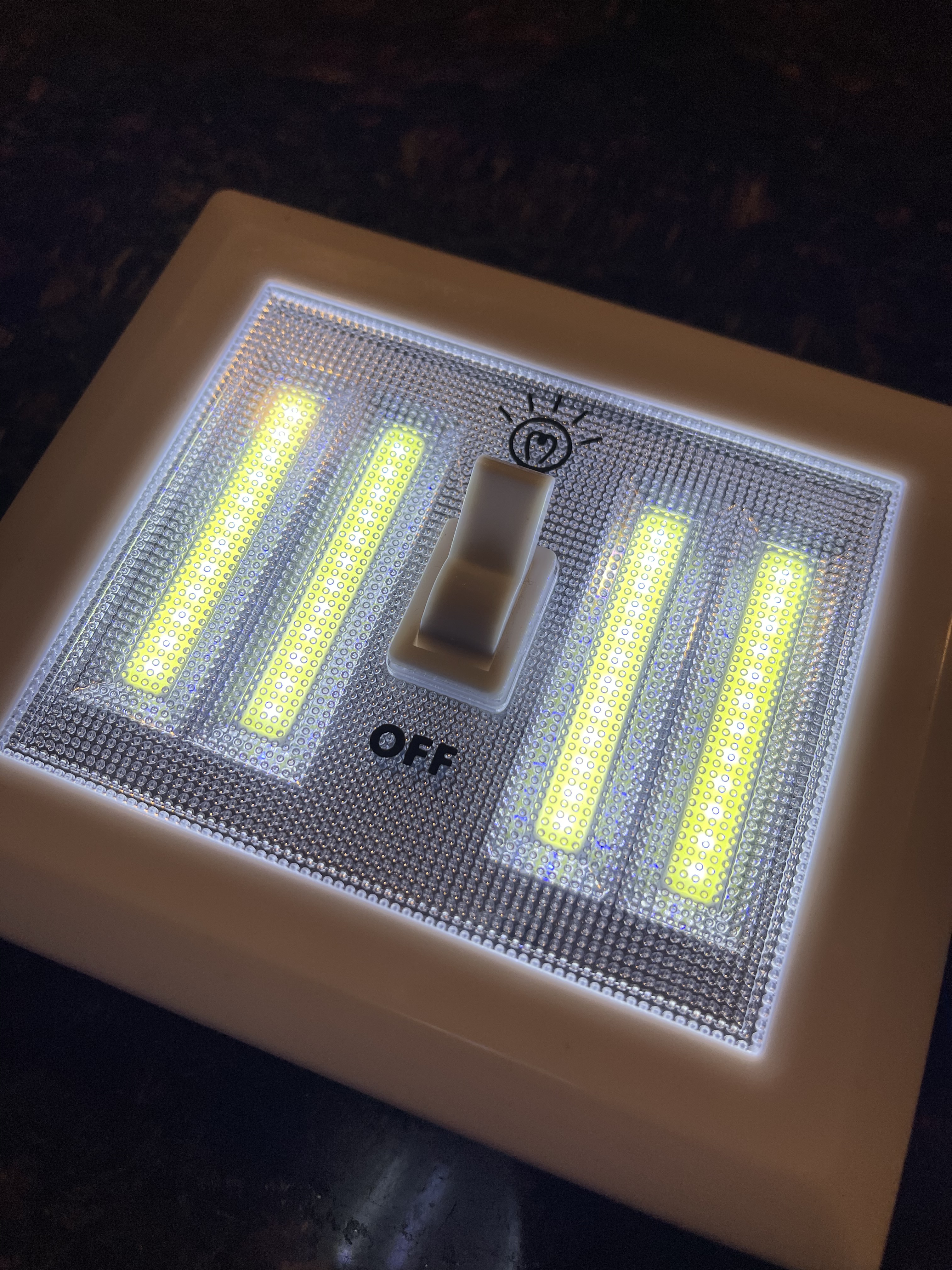
Emergency light switch given to me as a Christmas gift from my Mom.

Grief is unpredictable and incredibly uneven. I’m functioning, working, accountable, meeting needs, living up to my obligations, and mostly happy, but even on my best days, I have to admit that I’m operating with very little margin. This means that the space between “okay” and “not okay” is razor-thin. This is new to me and if I’m honest, really strange and uncomfortable. I am the one who is unfazed, unfrazzled, composed, and in control. I don’t wear my emotions on my sleeve but lately, I’ve been walking around with the emotional weight of a boulder, the inescapable heaviness of grief. It’s exhausting.

I’m not sure if grief has a sidekick, but if it does, it has to be memories. This is a tricky, little sidekick because it brings great joy and stinging pain. I have such great memories of my Mom! And while these memories remind me of her loss, it’s these same memories that are currently carrying me through my grief. So many wonderful memories that bring smiles and lots of laughter. Memories that produce happiness, and true light…both literally and figuratively.

In February, Kansas and much of the Midwest experienced record-breaking cold. In fact, there was one day where the temperature in my town was colder than the temps in all of Alaska! Forecasters had been predicting the cold spell complete with negative wind chills and harsh conditions, but things got serious with talk of losing electricity…not just for hours but for possibly days. The predictions became reality late one night. The power outage brought our household scrambling to the dining room table. In true survivalist mode, we each set out to retrieve flashlights and a weather radio. It was in that dark moment that there was not only a light but several lights as we each recovered light sources that had all been gifted to us over the years by my Mom. Camping lanterns, push lights, industrial flashlights, and even a battery-operated light switch—all from Mom!

After the “flash.” Ortiz Family Christmas 2017

At first, we laughed. Why had she given us so many lights over the years? Then we remembered Christmas 2017 when everyone received the light switches as gifts and how funny it was to watch each other get blinded by those lights! So much laughter! Thanks to Mom, on that record-breaking cold night in February, we had enough lights for every bedroom, every bathroom, and the kitchen. This was so my Mother—always looking out for us, prepared at every turn, giving us things she knew we would someday need. I am so grateful.

…when surrounded by darkness, always move toward the light…it is love’s glow.

A Life Interrupted

This scene reminded me of a dream I had just before Thanksgiving. It was a dream that I’ve had many times over the years, a dream about trying to get home. It always begins the same. I’m trying to walk home from the zoo in my hometown. It’s dark (I hate the dark) and I’m alone. I know exactly where I’m at, I know exactly where I’m going, and I know exactly how to get there, but I’m paralyzed by fear because I can’t see where I’m going. There’s just not enough light. In the dream, I start and stop often and I never make it home. When I dreamt this dream in November, it was exactly the same except when I stopped in a neighborhood near the courthouse I saw a light turn on in a nearby house. Then another light turned on at the next house followed by another at a house down the street. On the second floor of an older home, the light turned on and I could see my Mother standing in the window, smiling.

I didn’t make it home in that dream. Although I was asleep I was incredibly stunned to see her. The reality of her loss could be felt even in my dreams as I started to cry and tried to get to her. Those tears eventually woke me up. I wouldn’t call it a bad dream, how could I? My Mother was in it! She was whole and well, she was looking out for me as she always did. She was lighting my way…literally and figuratively the light I needed just when I needed it.

There’s a reason we equate grief with darkness. Most of us hate the dark, It’s unnerving, disorienting, scary, and uncomfortable. It causes fear, worry, stress, sadness, and even anger. It can be paralyzing, but we are not helpless. It’s important to note that in darkness AND grief it takes time for our senses to adjust. During this season, one must look for landmarks (familiar people, places, and things) to help navigate the journey. Remember, have faith as each step forward builds confidence and trust. And most importantly, on hard days, when surrounded by darkness, always move toward the light…it is love’s glow.

The light shines in the darkness, and the darkness has not overcome it. John 1:5


“A Life Interrupted” is an ongoing series of blog posts dealing with the loss of my mother to COVID-19.

The First Thanksgiving: Pairing Grief AND Gratitude (A Life Interrupted)

Sometimes, only one person is missing, and the whole world seems depopulated.

Alphonse de Lamartine, author
The Thanksgiving Table (November 2020)

I did it. But I wish I didn’t have to.

I made a full Thanksgiving meal on my own. I roasted a turkey. Peeled a mountain of potatoes. Used the drippings to make gravy. Baked a pan full of dressing, green beans, dinner rolls, an apple crumb pie, plus loads of turkey-themed cookies. I even opened a can of cranberry sauce (it’s okay, you can laugh at me). In all my 45 years of life, I’ve never done this before…never attempted to, never wanted to, and never needed to—but these are strange times that we’re living in and strange times apparently demand complete turkey dinners on Thanksgiving…especially when your Mom is gone.

The duality of living in today’s pandemic is evident everywhere you go. In one day you can see groups of friends hanging out and carrying on without a care in the world and turn the corner to see fully masked families heading into the local grocery store. Our elderly suffer from isolation in their golden years and our healthcare workers are overwhelmed and stressed while millions of others continue to call COVID-19 a hoax to their faces. Daily, Americans walk through temperature checkpoints to get to school, work, or to travel while others plan block parties and the like. There are rallies and protests. I even read about some well-meaning parents who hosted a homecoming dance and now dozens of kids have tested positive. I’m not judging. My own family walks in this duality. We occasionally see local friends, we work outside our home, my kids go to the gym, play sports, and try to maintain normalcy all while walking this line with masks in hand. I jokingly remind them “it’s COVID out there” and ask them to stay socially distanced as they head out the door. When they come home, I greet them and immediately send them to the sink to wash their hands. We’re not perfect. At this point in the pandemic, we’ve all had moments where we’ve let our guard down and subsequently prayed that we don’t pay the penalty. Strange times, indeed.

Nine months in and I can no longer count the number of family members who have contracted COVID-19 on my fingers. I don’t want to attempt to count the number of people in my circle who have had it and my heart breaks when I think about how the Coronavirus has affected my hometown in western Kansas. I have prayed for a number of individuals who have battled, struggled, and won. Praise God! And I have cried for those who weren’t so fortunate. As I write this the death toll in the United States is 267,000+

My mother is one of them.

It’s bizarre to grieve in a pandemic. The normal grieving process is both individual and communal, but when you can’t see family members for fear of contracting or spreading a virus, the grieving process becomes even more peculiar. And when your lost loved one is a victim of that same pandemic, you proceed cautiously and carefully. Honestly, there are days where it feels like you’re barely proceeding at all—like you’re standing still while the world has moved on.

You know the saying, “once bitten, twice shy?” Those are the eggshells that I walk on daily. I know how devastating and life-changing this virus can be. There are hundreds of thousands of people who should have been at the Thanksgiving table with their families this year, but they’re not. Empty chairs, not just in my home, but everywhere. Traditions not just broken, but shattered. Those of us who have lost family members and friends to COVID-19 are experiencing this heartbreak over and over as the narrative has gone from “we’re all in this together” to “there’s nothing to see here, folks.” And yet the pandemic and the loss of life go on.

There are hundreds of thousands of people who should have been at the Thanksgiving table with their families this year, but they’re not. Empty chairs, not just in my home, but everywhere. Traditions not just broken, but shattered.

a Life Interrupted

As we move into this unusual holiday season I can feel myself picking up the pieces of my broken heart non-stop. Normal Thanksgiving meant a road trip across the state with my kids. Normal Thanksgiving meant consulting with my mom, sister and sisters-in-law about what we would each contribute to the meal. Normal Thanksgiving meant hugs and seeing my nieces and nephews. Normal Thanksgiving is game nights, snacks and cousin sleepovers. Normal Thanksgiving is coffee with my best friend. Normal Thanksgiving meant going to my mom’s house instead of making a complete Thanksgiving meal on my own.

I did it. But I wish I didn’t have to. In fact, I would have traded anything for it not to be the way that it is.

It was the first Thanksgiving without my Mom and at every turn, we paired our grief with gratitude. I miss my mother so much and my appreciation for the time we had together has continuously grown. Today, I am even more thankful and grateful for her love and influence on my life. Often times I feel like my mother’s memory lives in the kitchen which was so appropriate as I prepared the meal. And while she has been on my mind constantly, in missing her this Thanksgiving I felt like she was very present…somehow still mothering me…urging me to make the most of the holiday, not just for me, but for my kids. That’s the kind of mother she was. Give, give, and give some more. Grieve, but be grateful. In the back of my mind, I kept hearing “keep the traditions.” In my heart, her memory confirmed the feeling that forward is the best option, the only option.

If you know me, you know I take tons of photos and videos. I document everything. (It’s the reporter in me). As Thanksgiving approached this year and the memories started popping up on social media, my daughter said to me, “Mom, I’m so glad you take all the photos and the videos so we can see and hear each other. It makes me sad, but it also makes me happy. We laugh a lot.” Taking photos and videos to share this Thanksgiving seemed extra important. And Casey is right, we do laugh a lot. In many ways, sharing photos and videos are the only way for the whole family to be together while we continue to grieve miles apart.

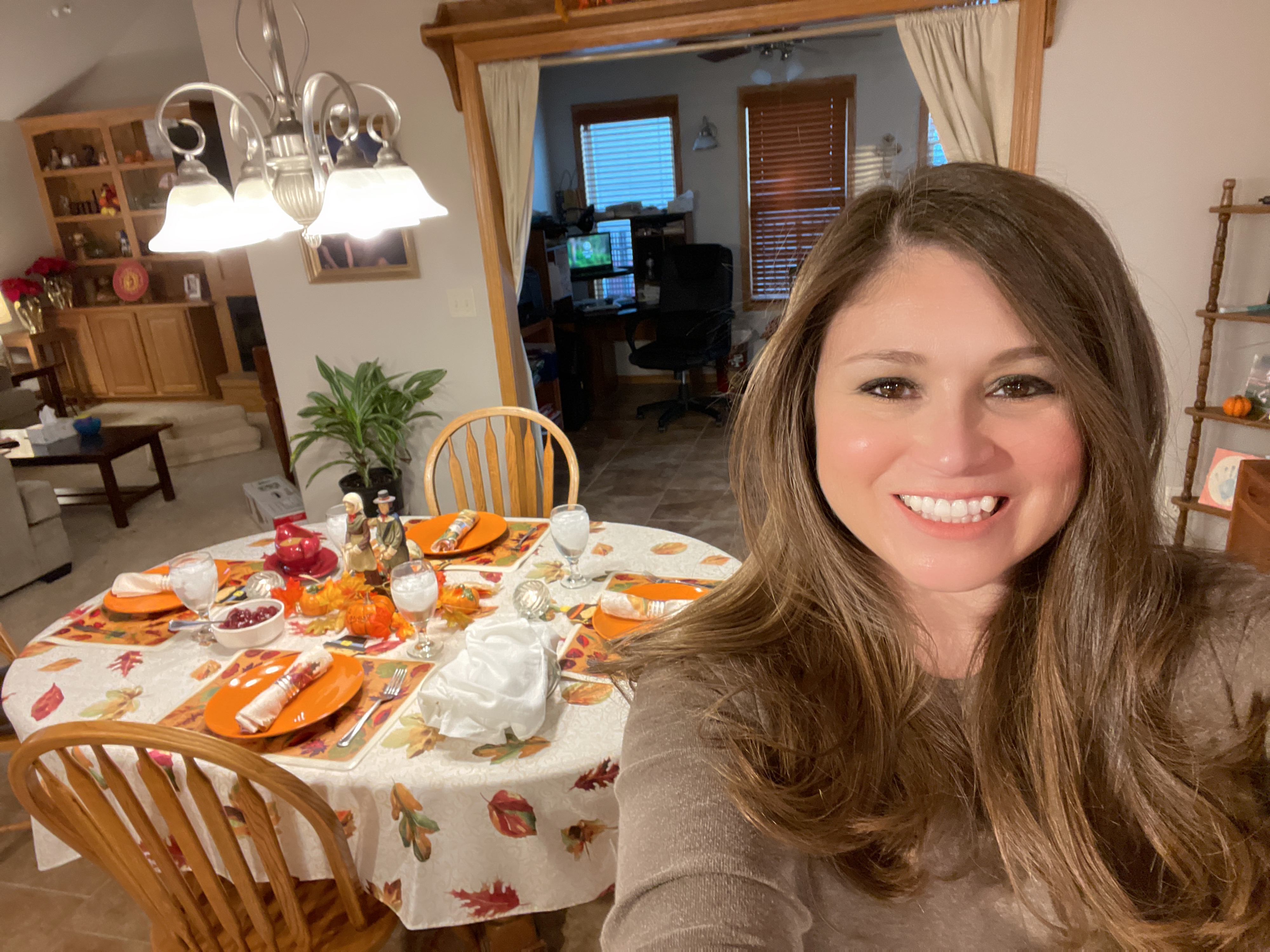
In the mix of photos I took this year is this one of me at our Thanksgiving table just before the meal was served with an accomplished grin on my face. And guess what, Mom? I didn’t break the oven like I did that time I tried making strudel! I know you’re proud…and maybe even a little bit relieved. We saved you a seat.

“In the day when I cried out, You answered me, and made me bold with strength in my soul.” Psalm 138:3


“A Life Interrupted” is an ongoing series of blog posts dealing with the loss of my mother to COVID-19.